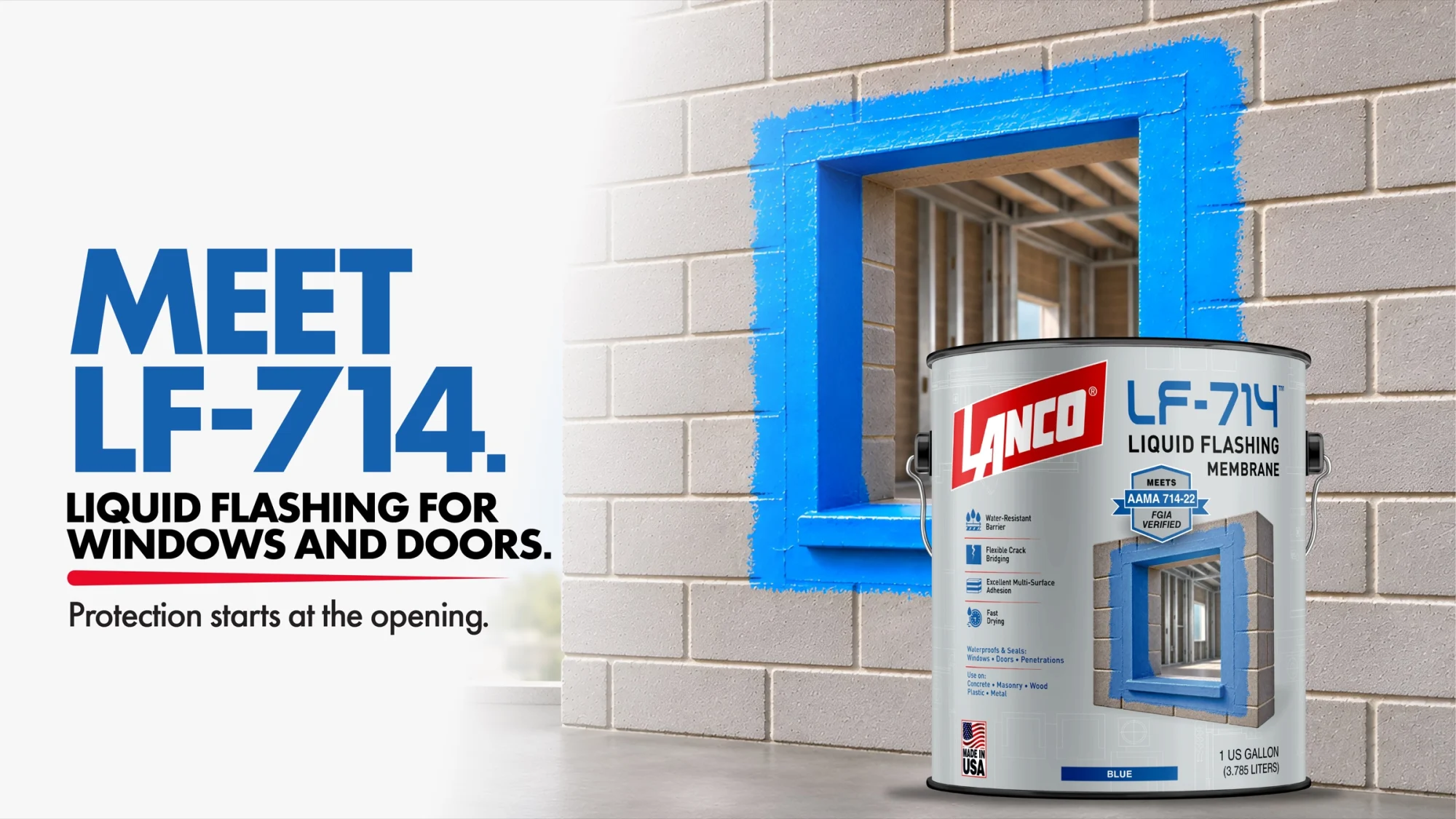
Lanco LF-714 is a liquid-applied flashing membrane for windows, doors and penetrations. One coat, no tape, that meets AAMA 714-22.
ONE COAT. NO TAPE. AAMA 714-22.
LF-714 cures into a single, continuous membrane that follows the shape of the opening, corners and all. Experienced applicators reach the recommended thickness in one coat, with no tape, fabric or primer.
What is flashing?
Flashing is a thin, water-impervious material installed at joints, penetrations and transitions to keep water out. It's part of the building's weatherproofing system: its job is to redirect water down and out, away from the most vulnerable areas.
You'll find flashing at chimneys, roof-to-wall intersections, vents, skylights, window and door openings. It comes in three general types:
- Metal flashing (aluminum, galvanized steel or copper), fastened mechanically and lapped at the joints. Common at chimneys, drip edges and head flashing over windows.
- Sheet membranes and self-adhered tapes (rubberized asphalt, butyl or synthetic sheets), held in place with pressure-sensitive adhesive. Common at window flanges, sill pans and WRB tie-ins.
- Liquid-applied flashing, which bonds directly to the substrate and cures in place. Built for rough openings, inside and outside corners, penetrations and complex transitions.
For window and door openings, the choice usually comes down to tape or liquid.
Why openings are the weak point
Rough openings are one of the highest-risk areas for water intrusion on any building. Four things work against them:
- Multiple material transitions. Sheathing, framing, the WRB and the window flange all meet in a few inches.
- Fasteners. Nails and screws pierce the assembly right where water collects.
- Movement. Thermal, structural and wind loads make materials shift at different rates.
- Wet and dry cycles. Repeated wetting and drying stress every seal around the opening.
When water gets past the flashing, it can end up behind the finish, in the framing or in the wall cavity. By the time it shows up as a stain, swelling or mold, the repair is far more expensive than getting the flashing right in the first place.
Tape vs. liquid flashing
Flashing tape has been the go-to for years, but it has a built-in limitation: it comes in strips. Covering an opening means overlapping pieces at the corners and seams, and folding tape into an inside corner often leaves wrinkles or small gaps. Each overlap and seam is a spot where water can find a path.
Liquid flashing takes a different approach. It goes on wet and cures into a single, continuous membrane that follows the shape of the opening, corners and all.
Tape still has its place: on simple, square openings it can be quick to install. But its performance depends on the integrity of every seam. Rigid materials can't follow building movement, and irregular openings are hard to seal consistently. Liquid flashing exists because these areas can't be reliably sealed with flat, rigid materials alone.
Meet LF-714
LF-714 is a water-based, modified acrylic liquid flashing membrane. It forms a continuous, seamless water-resistive barrier at window and door rough openings. Once cured, it stays flexible, so it can accommodate normal substrate movement without cracking.
Here's what sets it apart:
- One coat. Experienced applicators can reach the recommended thickness in a single coat, which cuts labor time.
- No tape, no fabric, no primer. It bonds to most common building materials without priming and doesn't need joint reinforcing tape.
- Flexible crack bridging. The cured film moves with the substrate instead of splitting.
- Works on damp openings. It's vapor permeable, so incidental moisture can escape.
- Built for masonry. High alkali resistance makes it suitable for new and aged masonry and concrete.
- Jobsite friendly. It's low-odor, under 50 g/L VOC, non-flammable and cleans up with water.
- Built-in quality check. The blue color shows at a glance where you've applied it and where you've missed.
LF-714 is made in the USA and comes in 1-gallon and 5-gallon containers.
How to apply LF-714 in four steps
Before you start, make sure the surface is clean, sound and free of dirt, grease, mildew, efflorescence and loose paint. Apply between 50°F and 95°F, out of direct sun, and never on frozen surfaces or standing water. Mix the product before use, and don't thin it.
- Brush or roll it on. Use a high-quality nylon or polyester brush, or a 1/4" to 1/2" nap roller depending on the surface texture. Apply evenly at a minimum of 30 wet mils for a continuous, pinhole-free membrane.
- Work it into every detail. Brush thoroughly into corners, seams, fasteners, penetrations and transitions.
- Extend past the opening. Carry LF-714 at least 4 to 6 inches beyond the opening onto the surrounding sheathing or framing for proper overlap and drainage.
- Install when it's dry to the touch. LF-714 is typically dry to the touch in 30 to 60 minutes, and you can install the window or door once it has skinned over.
If you apply it in more than one pass, let the first coat dry to the touch before adding the next. Allow about 24 hours for full cure before prolonged moisture exposure or adding other air or water-resistive barrier components. Cooler temperatures, higher humidity and thicker coats will slow drying.
Where to use it
LF-714 is made for above-grade work on both residential and commercial projects:
- Window openings. Apply to sills, jambs and heads for a continuous seal around the rough opening.
- Door openings. Seal thresholds, jambs and heads where water tends to collect.
- CMU openings and recessed details. It handles block openings and recessed window and door detailing.
- Penetrations. It conforms to pipes, conduits and fasteners to keep the flashing continuous.
- Seams, corners and transitions. Use it at sheathing-to-framing transitions and to tie into weather-resistive barrier (WRB) systems.
LF-714 bonds without primer to the materials you'll find around a typical opening:
- Masonry and concrete: CMU block, poured concrete and stucco
- Wood and sheathing: plywood, OSB, wood framing and studs, ZIP System® sheathing, fiberboard, foam insulated sheathing and exterior gypsum
- Weather-resistive barriers: building paper, felt paper, polyolefin housewraps, and films or coated laminates
- Plastics and metals: PVC, ABS, and bare or painted aluminum and steel
It can also go on damp surfaces and green concrete, as long as the surface has set, is firm and has no standing water.
How far a gallon goes
One gallon of LF-714 covers about 55 square feet at 30 wet mils (15 mils dry). At a 6-inch flashing width, that's roughly 100 linear feet, enough for nearly three typical 3' × 5' windows. That's about the same length as two 50-foot rolls of 6-inch flashing tape, without a single seam to overlap.
Here's how that works out for a typical 3' × 5' window, counting both the face of the wall and the returns into the opening:
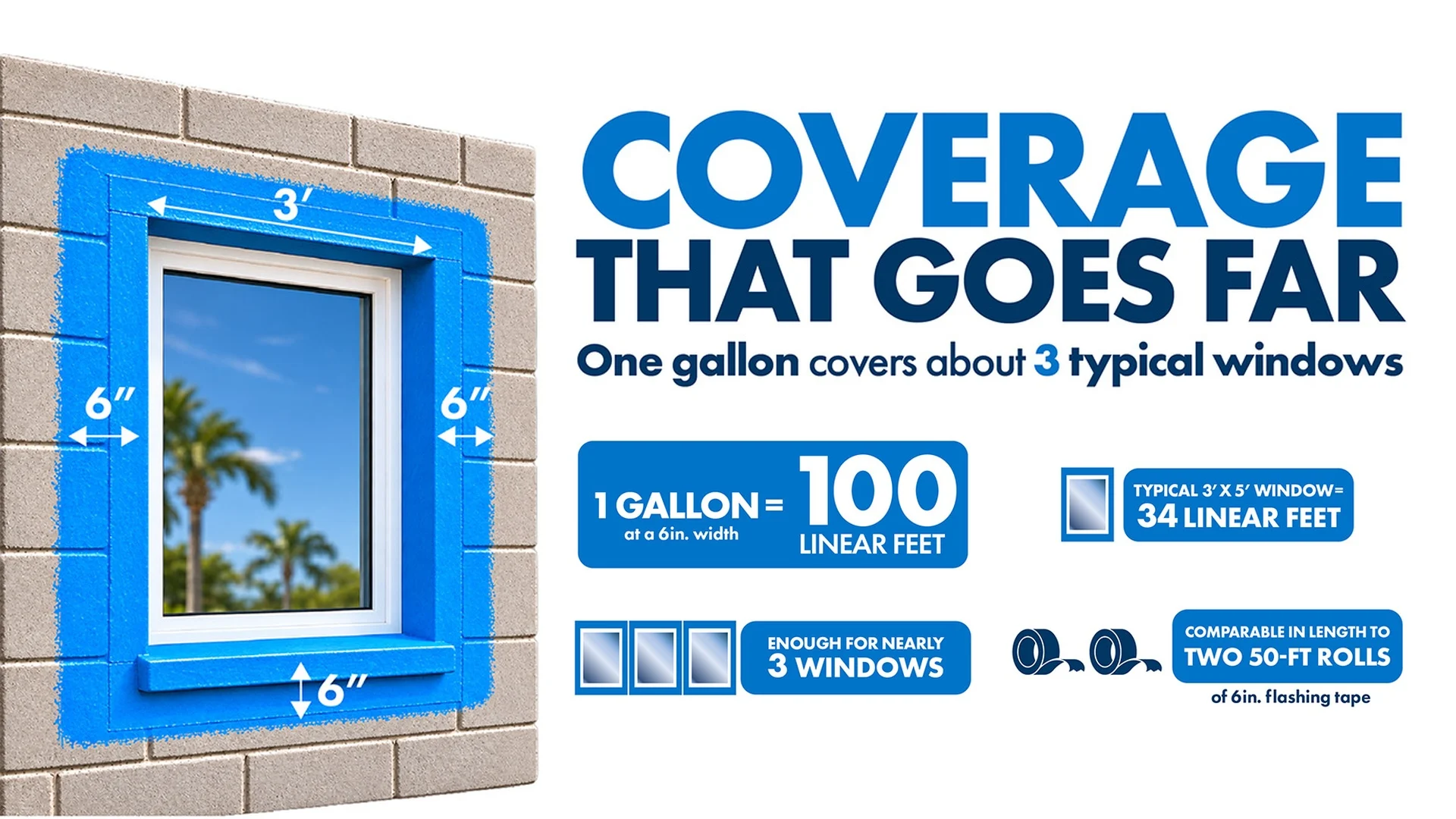
At 34 linear feet per window, 100 feet covers nearly three windows.
Actual coverage depends on surface porosity, irregularities and application method, so plan a little extra for rough masonry.
Verified to the current industry standard
LF-714 passes AAMA 714-22, the current specification for liquid-applied flashing used to create a water-resistive seal around exterior wall openings. It's also an FGIA-verified component.
The Fenestration and Glazing Industry Alliance (FGIA) publishes the AAMA specifications for window flashing, one for each type:
- AAMA 711-22 for self-adhering flashing (tapes)
- AAMA 712-14 for mechanically attached flashing (metal)
- AAMA 714-22 for liquid-applied flashing
That's where LF-714 gets its name. To meet AAMA 714-22, a liquid flashing has to pass a series of ASTM tests that reflect real conditions at the opening:
| Test | What it measures | Why it matters |
|---|---|---|
| ASTM D1970 / C794 | Adhesion | Flashing has to stick to common building surfaces |
| ASTM D412 | Tensile strength and elongation | Shows how well it flexes with movement |
| ASTM D2247 | Water resistance under humidity | Simulates wet wall-cavity conditions |
| ASTM G154 | UV exposure | Confirms it won't break down in sunlight |
| ASTM C1305 | Crack bridging | It must stay watertight across moving cracks |
| ASTM E331 | Water penetration | Tested as part of a full wall assembly |
For architects, specifiers and builders, that means you have a recognized standard to point to on the spec sheet and on the jobsite, not just a manufacturer's claim.
Good to know before you start
- Prep matters. Lightly sand glossy surfaces, roughen smooth or burnished concrete, and repair or reinforce any cracks or gaps wider than 1/16 inch before you start. Clean mildew and efflorescence completely.
- Check old coatings. On previously painted surfaces, remove anything loose or flaking, and run an adhesion test if you're unsure.
- Know the limits. LF-714 isn't meant for surfaces with active leaks, negative hydrostatic pressure or excessive vapor transmission. It's also not for floors, traffic-bearing surfaces or areas that stay submerged.
- Store it right. Keep containers upright, tightly closed and protected from freezing, and don't store above 105°F. Unopened, it has a 24-month shelf life.
Read the label before you start
As always, read the label and the Safety Data Sheet before use, and wear eye protection, gloves and protective clothing.
Expert Support
Not sure which product is right for you?
Have a window, door or penetration detail to solve? Our team can help you spec LF-714 for your substrate and conditions.